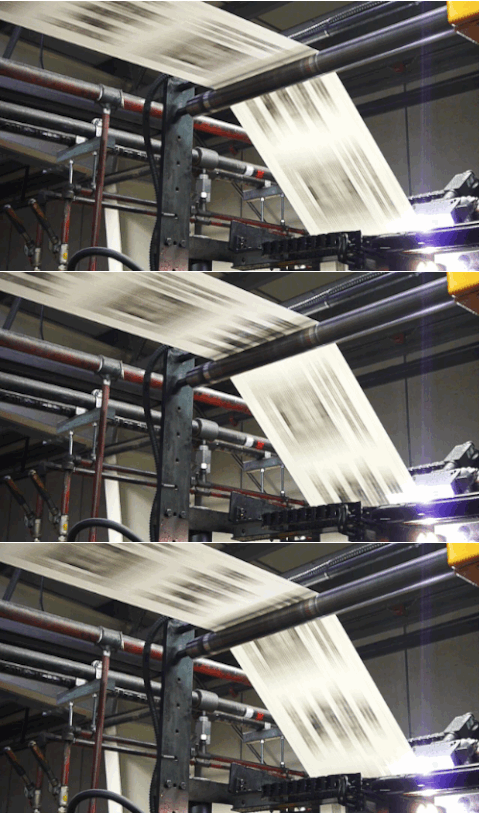
Classification-
Industry is the production of goods or related services within an economy. The major source of revenue of a group or company is the indicator of its relevant industry. When a large group has multiple sources of revenue generation, it is considered to be working in different industries. Manufacturing industry became a key sector of production and labour in European and North American countries during the Industrial Revolution, upsetting previous mercantile and feudal economies. This came through many successive rapid advances in technology, such as the production of steel and coal.
Following the Industrial Revolution, possibly a third of the world's economic output are derived that is from manufacturing industries. Many developed countries and many developing/semi-developed countries (People's Republic of China, India etc.) depend significantly on manufacturing industry. Industries, the countries they reside in, and the economies of those countries are interlinked in a complex web of interdependence.
Industries can be classified in a variety of ways. At the top level, industry is often classified according to the three-sector theory into sectors: primary (extractive), secondary(manufacturing), and tertiary (services). Some authors add quaternary (knowledge) or even quinary (culture and research) sectors. Over time, the fraction of a society's industry within each sector changes.
Below the economic sectors there are many other more detailed industry classifications. These classification systems commonly divide industries according to similar functions and markets and identify businesses producing related products.
Industries can also be identified by product, such as: construction industry, chemical industry, petroleum industry, automotive industry, electronic industry, power engineering and power manufacturing (such as gas or wind turbines), meatpacking industry, hospitality industry, food industry, fish industry, software industry, paper industry, entertainment industry, semiconductor industry, cultural industry, and poverty industry.
Market-based classification systems such as the Global Industry Classification Standard and the Industry Classification Benchmark are used in finance and market research.

Entertainment Industry-
Television is one of the major mass media of India and is a huge industry and has thousands of programs in all the states of India. Today India boasts of being the second largest television market in the world. The small screen has produced numerous celebrities of their own kind some even attaining national fame. TV soaps are extremely popular with housewives as well as working women. Approximately half of all Indian households own a television. Television first came to India in the form of Doordarshan (DD) on Sept 15, 1959. Doordarshan is the National Television Network of India and also one of the largest broadcasting organisations in the world. Apart from the state run Doordarshan, there are six DTH players with 54.52 million DTH users in India with the present prediction; it is likely to overtake the US in terms of the largest DTH market in the world. As of 2012, the country has a collection of free and subscription services over a variety of distribution media, through which there are over 823 channels of which 184 are pay channels. Total television viewership of 415 million is amongst the world’s highest with nearly 15-16 Television companies beaming programmers to India. The major players being Doordarshan, STAR TV (Satellite Television Asia Network), Zee Television, United Television, CNN, Sony Television, ATN (Asia Television Network), BBC World, SUN TV, Discovery Channel, TNT and Others. India’s television business has an estimated $3.4 billion in revenue in 2005, according to PricewaterhouseCoopers. With the government is focusing more on Digitalisation, TV distribution is taking new shape Digitalisation has been a major challenge for the government as digital cable is not gaining momentum. According to the new deadline, pan India digitalisation us expected to happen by December 31, 2014. Another challenge for the Television Industry is Average Revenue Per User (ARPU). India is amongst the countries with lowest ARPU as compared to developed countries like US and UK where ARPU is around US$45 to US$60, India has an ARPU approximately US$3.5.
Films are the most important form of entertainment in India. Film industry in India is among the largest in the world in terms of films produced (approximately 1000) in different languages which include films in Hindi, Kannada, Bengali, Tamil,marathi, Telugu, Punjabi and Malayalam. Approximately twenty-three million Indians go to see a film every day. Film Federation of India is the apex body of film industry in India whose objective is to popularise and promote the cinema Bollywood accounts for 46 percent of the total Indian film industry revenues film industry experts. According to unofficial estimates available in January 2001, the Indian film industry has an annual turnover of Rs. 60 billion (approximately US$1.33 billion). It employs more than 6 million people, most of whom are contract workers as opposed to regular employees. As at the start of 2001, a reasonable budget film in Hindi could cost US$1.75 million. A low budget Hindi film can be made for even as low as Rs. 15 million. A big budget Hindi movie can cost in excess of US$30 million. The 'bigness' of the budget is attributable mainly to the high fees paid to 'stars', celebrated music directors, high-end technologies and expensive travel costs to shoot in exotic locations worldwide. At the time of writing, it is believed that 'stars' like Shah Rukh Khan and Salman Khan are paid around Rs. 100 million (US$440,000) per film. India has a National Film Development Corporation (NFDC) which finances some films. A few film makers, who would find it hard to obtain finance from the regular sources, have been financed by the NFDC.[17] However, NFDC cannot be considered to play a central role in the film industry because it finances too few films which, too, are not of the type that has made the Indian film industry so vibrant.
Radio broadcasting in India started in British India in 1923 with the Radio Club of Bombay. All India Radio (AIR) was established in 1936 which is one of the largest radio networks in the world including the AIR FM. AM, FM and even Satellite Radio have made a huge impact on the Industry in India. Most of the media houses either already have a presence in the industry or are looking to get a license in the next round. Famous stations are Radio Mirchi (of the Times Group) has maintained a lead position in most cities it operates in and other channels like Radio City, Red FM, Big FM, Fever, Radio One have also been able to get significant traction.Till 1990 Indian economy was closed, no private player was allowed to enter and Akashwani has the sole responsibility to cater to the wide and culturally diverse Indian consumer base. In the last 5 years, the Radio industry in India has seen a compound annual growth rate of approximately 20% and has grown to a size of around Rs. 8.3 billion in 2008. By the end of the 2010, there were 245 active radio stations in India and had a market size of INR 10 billion. It registered a cumulative growth rate of 11 percent from 2007 to 2010. The industry is projected to grow at a CAGR of 20 percent over 2010- 2015 and is expected to be INR 25 billion in terms of revenue. Phase III privatisation of the radio FM is expected to add 839 new radio stations in 294 cities. The government has approved Foreign Direct Investment (FDI) in FM radio channels to 26 percent from the current 20 percent. Ministry of Information and broadcasting is planning to release additional frequencies in all markets, automatic renewal of license at the end of the initial term of the license of the term. One of the major reasons for such an interest in the industry is the increased profitability. The government has cut the license fees to 1/10th of the previous amount.
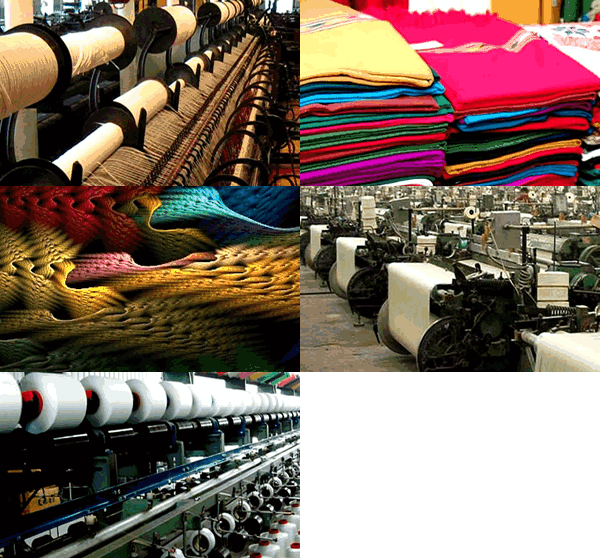
Textile Industry-
The textile industry in India traditionally, after agriculture, is the only industry that has generated huge employment for both skilled and unskilled labour in textiles. The textile industry continues to be the second-largest employment generating sector in India. It offers direct employment to over 35 million in the country.The share of textiles in total exports was 11.04% during April–July 2010, as per the Ministry of Textiles. During 2009–2010, the Indian textile industry was pegged at US$55 billion, 64% of which services domestic demand.In 2010, there were 2,500 textile weaving factories and 4,135 textile finishing factories in all of India. According to AT Kearney’s ‘Retail Apparel Index’, India was ranked as the fourth most promising market for apparel retailers in 2009.
India is first in global jute production and shares 63% of the global textile and garment market. India is second in global textile manufacturing and also second in silk and cotton production. 100% FDI is allowed via automatic route in textile sector. Rieter, Trutzschler, Soktas, Zambiati, Bilsar, Monti, CMT, E-land, Nisshinbo, Marks & Spencer, Zara, Promod, Benetton, and Levi’s are some of the foreign textile companies invested or working in India.
The archaeological surveys and studies have found that the people of Harrapan civilization knew weaving and the spinning of cotton four thousand years ago. Reference to weaving and spinning materials is found in the Vedic Literature. There was textile trade in India during the early centuries. A block printed and resist-dyed fabrics, whose origin is from Gujaratis found in tombs of Fostat, Egypt. This proves that Indian export of cotton textiles to the Egypt or the Nile Civilization in medieval times were to a large extent. Large quantity of north Indian silk were traded through the silk route in China to the western countries. The Indian silk were often exchanged with the western countries for their spices in the barter system. During the late 17th and 18th century there were large export of the Indian cotton to the western countries to meet the need of the European industries during industrial revolution. Consequently, there was development of nationalist movement like the famous Swadeshi movement which was headed by the Aurobindo Ghosh.
India is the second largest producer of fibre in the world and the major fibre produced is cotton. Other fibres produced in India include silk, jute, wool, and man-made fibers. 60% of the Indian textile Industry is cotton based. The strong domestic demand and the revival of the Economic markets by 2009 has led to huge growth of the Indian textile industry. In December 2010, the domestic cotton price was up by 50% as compared to the December 2009 prices. The causes behind high cotton price are due to the floods in Pakistan and China . India projected a high production of textile (325 lakh bales for 2010 -11). There has been increase in India's share of global textile trading to seven percent in five years.The rising prices are the major concern of the domestic producers of the country.
Man Made Fibres: This includes manufacturing of clothes using fibre or filament synthetic yarns. It is produced in the large power loom factories. They account for the largest sector of the textile production in India.This sector has a share of 62% of the India's total production and provides employment to about 4.8 million people.
The Cotton Sector: It is the second most developed sector in the Indian Textile industries. It provides employment to huge amount of people but its productions and employment is seasonal depending upon the seasonal nature of the production.
The Handloom Sector: It is well developed and is mainly dependent on the SHGs for their funds. Its market share is 13%. of the total cloth produced in India.
The Woolen Sector: India is the 7th largest producer. of the wool in the world. India also produces 1.8% of the world's total wool.
The Jute Sector: The jute or the golden fiber in India is mainly produced in the Eastern states of India like Assam and West Bengal. India is the largest producer of jute in the world.
The Sericulture and Silk Sector: India is the 2nd largest producer of silk in the world. India produces 18% of the world's total silk. Mulberry, Eri, Tasar, and Muga are the main types of silk produced in the country. It is a labor-intensive sector.
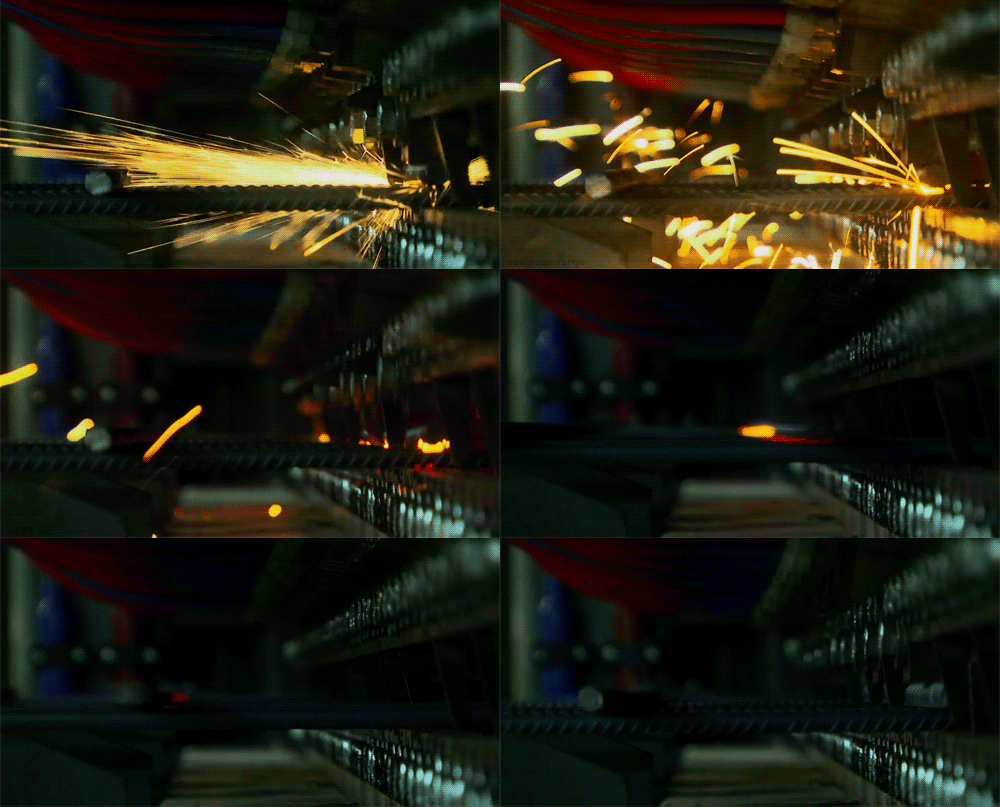
Iron & Steel Industry-
The iron and steel industry is one of the most important industries in India. During 2014 through 2015, India was the third largest producer of raw steel and the largest producer of sponge iron in the world. The industry produced 91.46 million tons of total finished steel and 9.7 million tons of pig iron. Most iron and steel in India is produced from iron ore. The Indian Ministry of Steel is concerned with: the coordination and planning of the growth and development of the iron and steel industry in the country, both in the public and private sectors; formulation of policies with respect to production, pricing, distribution, import and export of iron and steel, ferro alloys and refractories; and the development of input industries relating to iron ore, manganese ore, chrome ore and refractories etc., required mainly by the steel industry.
Most of the public sector undertakings market their steel through the Steel Authority of India (SAIL).
There are two types of steel plants - mini steel plants and integrated steel plants.
Mini steel plants are smaller, have electric furnaces, use steel scrap and sponge iron. They have re-rollers that use steel ingots as well. They produce and introduce mild and alloy steel of certain specifications. There are around 650 mini steel plants in India.
Integrated steel plants are large, handle everything in one complex - from putting together raw material to steel making, rolling and shaping. Iron ore, coke, and flux are fed into the blast furnace and heated. The coke reduces the iron oxide in the ore to metallic iron, and the molten mass separates into slag and iron. Some of the iron from the blast furnace is cooled, and marketed as pig iron; the rest flows into basic oxygen furnaces, where it is converted into steel. Iron and steel scrap may be added to both to the blast furnace and to the basic iron furnace. There are about five integrated SAIL plants in India.
National steel policy – 2005 has the long-term goal of having a modern and efficient steel industry of world standards in India. The focus is to achieve global competitiveness not only in terms of cost, quality, and product-mix but also in terms of global benchmarks of efficiency and productivity. The Policy aims to achieve over 100 million metric tonnes of steel per year by 2019-20 from the 2004-05 level of 38 mT. This implies an annual growth of around 7.3% per year from 2004-5 onward.
The strategic goal above is justified because steel consumption in the world, around 1000 million metric tonnes in 2004, is expected to grow at 3.0% per annum to reach 1,395 million metric tonnes in 2015, compared to 2% per annum in the past fifteen years. China will continue to have a dominant share of the demand for world steel. Domestically, the growth rate of steel production over the past fifteen years was 7.0% per annum. The projected growth rate of 7.3% per annum in India compares well with the projected national income growth rate of 7-8% per annum, given an income elasticity of steel consumption of around 1.
The policy targets to achieve production of 300 million tonnes by 2030-31.· The policy has also proposed the idea of gas-based steel plants and use of electric furnaces in order to bring down the use of coking coal in blast furnaces. · This has been proposed in order to tap cheap imported raw materials such as coking coal and export the output without incurring huge cost burden. · The policy proposes setting up Greenfield Steel Plants along the Indian coastline under the Sagarmala Project. · The aim of the draft NSP is to develop a self-sufficient steel industry that is globally competitive. · Cheap imports from China, Korea and other countries are also a matter of concern for domestic producers. Reforms Proposed By the Draft National Steel Policy · High input costs. · Quality of metallurgical coke is not good enough. Coke is the raw material used in blast furnace iron making. It is made through carbonization of coal. · Lack of domestic demand. · Steel companies are plagued with huge debts. ·Subsequent steel policies have been drafted each year. The Indian Ministry of Steel has released draft National Steel Policy (NSP), 2017. Problems Faced By This Sector

Construction industry-
The Construction industry of India is an important indicator of the development as it creates investment opportunities across various related sectors. The construction industry has contributed an estimated US$ 308 billion to the national GDP in 2011-12 (a share of around 19%). The industry is fragmented, with a handful of major companies involved in the construction activities across all segments; medium-sized companies specializing in niche activities; and small and medium contractors who work on the subcontractor basis and carry out the work in the field. In 2011, there were slightly over 500 construction equipment manufacturing companies in all of India. The sector is labor-intensive and, including indirect jobs, provides employment to more than 35 million people.
The period from 1970 to mid 60’s witnessed the government playing an active role in the development of these services and most of construction activities during this period were carried out by state owned enterprises and supported by government departments. In the first five-year plan, construction of civil works was allotted nearly 50 per cent of the total capital outlay.
The first professional consultancy company, National Industrial Development Corporation (NIDC), was set up in the public sector in 1954. Subsequently, many architectural, design engineering and construction companies were set up in the public sector (Indian Railways Construction Limited (IRCON), National Buildings Construction Corporation (NBCC), Rail India Transportation and Engineering Services (RITES), Engineers India Limited (EIL), etc.) and private sector (M N Dastur and Co., Hindustan Construction Company (HCC), Ansals, etc.).
In India Construction has accounted for around 40 per cent of the development investment during the past 50 years. Around 16 per cent of the nation's working population depends on construction for its livelihood. The Indian construction industry employs over 30 million people and creates assets worth over ₹ 200 billion.
It contributes more than 5 per cent to the nation's GDP and 78 per cent to the gross capital formation. Total capital expenditure of state and central govt. will be touching ₹8,021 billion in 2011-12 from ₹ 1,436 billion (1999-2000).
The share of the Indian construction sector in total gross capital formation (GCF) came down from 60 per cent in 1970-71 to 34 per cent in 1990-91. Thereafter, it increased to 48 per cent in 1993-94 and stood at 44 per cent in 1999-2000. In the 21 st century, there has been an increase in the share of the construction sector in GDP and capital formation.
GDP from Construction at factor cost (at current prices) increased to ₹ 1.745 billion (12.02% of the total GDP ) in 2004-05 from ₹ 1,162.38 billion (10.39% of the total GDP) in 2000-01.
The main reason for this is the increasing emphasis on involving the private sector infrastructure development through public-private partnerships and mechanisms like build-operate-transfer (BOT), private sector investment has not reached the expected levels.
The Indian construction industry comprises 200 firms in the corporate sector. In addition to these firms, there are about 120,000 class A contractors registered with various government construction bodies. There are thousands of small contractors, which compete for small jobs or work as sub-contractors of prime or other contractors. Total sales of construction industry have reached ₹ 428854 million in 2004 05 from ₹ 214519 million in 2000-01, almost 20% of which is a large contract for Benson & Hedges.

Automotive Industry-
The automotive industry in India is one of the largest in the world with an annual production of 23.96 million vehicles in FY (fiscal year) 2015–16, following a growth of 2.57 per cent over the last year. The automobile industry accounts for 7.1 per cent of the country's gross domestic product (GDP). The Two Wheelers segment, with 81 per cent market share, is the leader of the Indian Automobile market, owing to a growing middle class and a young population. Moreover, the growing interest of companies in exploring the rural markets further aided the growth of the sector. The overall Passenger Vehicle (PV) segment has 13 per cent market share.
India is also a prominent auto exporter and has strong export growth expectations for the near future. In FY 2014–15, automobile exports grew by 15 per cent over the last year. In addition, several initiatives by the Government of India and the major automobile players in the Indian market are expected to make India a leader in the Two Wheeler (2W) and Four Wheeler (4W) market in the world by 2020.
The industry produced a total 14.25 million vehicles including PVs, commercial vehicles (CVs), three wheelers (3W) and 2W in April–October 2015, as against 13.83 in April–October 2014, registering a marginal growth of 3.07 per cent, year-to-year.
The sales of PVs grew by 8.51 per cent in April–October 2015 over the same period in the previous year. The overall CVs segment registered a growth of 8.02 per cent in April–October 2015 as compared to same period last year. Medium and Heavy Commercial Vehicles (M&HCVs) registered very strong growth of 32.3 per cent while sales of Light Commercial Vehicles (LCVs) declined by 5.24 per cent during April–October 2015, year-to-year.
In April–October 2015, overall automobile exports grew by 5.78 per cent. PVs, CVs, 3Ws and 2Ws registered growth of 6.34 per cent, 17.95 per cent, 18.59 per cent and 3.22 per cent, respectively, in April–October 2015 over April–October 2014.
In order to keep up with the growing demand, several auto makers have started investing heavily in various segments of the industry during the last few months. The industry has attracted foreign direct investment (FDI) worth US$13.48 billion during the period April 2000 to June 2015, according to data released by Department of Industrial Policy and Promotion (DIPP).
Some of the major investments and developments in the automobile sector in India are as follows:
Global auto maker Ford plans to manufacture in India two families of engines by 2017, a 2.2 litre diesel engine code-named Panther, and a 1.2 litre petrol engine code-named Dragon, which are expected to power 270,000 Ford vehicles globally.
The world's largest air bag suppliers Autoliv Inc, Takata Corp, TRW Automotive Inc and Toyoda Gosei Co are setting up plants and increasing capacity in India.
General Motors plans to invest US$1 billion in India by 2020, mainly to increase the capacity at the Talegaon plant in Maharashtra from 130,000 units a year to 220,000 by 2025.
US-based car maker Chrysler has planned to invest Rs 3,500 crore (US$525 million) in Maharashtra, to manufacture Jeep Grand Cherokee model.
Mercedes Benz has decided to manufacture the GLA entry SUV in India. The company has doubled its India assembly capacity to 20,000 units per annum.
Germany-based luxury car maker Bayerische Motoren Werke AG's (BMW) local unit has announced to procure components from seven India-based auto parts makers.
Mahindra Two Wheelers Limited (MTWL) acquired 51 per cent shares in France-based Peugeot Motorcycles (PMTC).

Economy of India-
The economy of India is the sixth-largest in the world measured by nominal GDP and the third-largest by purchasing power parity (PPP). The country is classified as a newly industrialised country, and one of the G-20 major economies, with an average growth rate of approximately 7% over the last two decades. India's economy became the world's fastest growing major economy in the last quarter of 2014, surpassing the People's Republic of China.[33] However, the country ranks 141st in per capita GDP (nominal) with $1723 and 123rd in per capita GDP (PPP) with $6,616 as of 2016.
The long-term growth prospective of the Indian economy is positive due to its young population, corresponding low dependency ratio, healthy savings and investment rates, and increasing integration into the global economy. The Indian economy has the potential to become the world's 3rd-largest economy by the next decade, and one of the two largest economies by mid-century. The International Monetary Fund (IMF) described the Indian economy as the "bright spot" in the global landscape. India topped the World Bank's growth outlook for the first time in fiscal year 2015–16, during which the economy grew 7.6%. Growth is expected to have declined slightly to 7.1% for the 2016–17 fiscal year. According to the IMF, India's growth is expected to rebound to 7.2% in the 2017–18 fiscal and 7.7% in 2018–19.
India has one of the fastest growing service sectors in the world with an annual growth rate above 9% since 2001, which contributed to 57% of GDP in 2012–13. India has become a major exporter of IT services, Business Process Outsourcing(BPO) services, and software services with $167.0 billion worth of service exports in 2013–14. This is the fastest-growing part of the economy. The IT industry continues to be the largest private-sector employer in India. India is the third-largest start-up hub in the world with over 3,100 technology start-ups in 2014–15 The agricultural sector is the largest employer in India's economy but contributes to a declining share of its GDP (17% in 2013–14). India ranks second worldwide in farm output. The industry sector has held a steady share of its economic contribution (26% of GDP in 2013–14). The Indian automobile industry is one of the largest in the world with an annual production of 21.48 million vehicles (mostly two and three wheelers) in 2013–14. India had $600 billion worth of retail market in 2015 and one of world's fastest growing e-commerce markets.